Monday, 23 February 2009

Comet Lulin

Click on image to enlarge

Object: C2007 N3 (Lulin)
Type: Comet
Distance: 63 million km at time of imaging
Constellation: Virgo
Date: 21 February 2009
Equipment: SXV-H9, Vixen 114mm aperture f5.3 ED refractor
Subframes: 6 x 60 seconds, 16 flats/flat darks, calibrated and stacked in AIP4Win, tweaked in PSP7.

Look out of kitchen window at 6 pm. Clear, dark, star-studded skies. Don cold weather gear, enter garage, set up equipment and wheel down to observing platform.

Look up in trepidation, given recent weather. Still clear, dark, star-studded skies.

Polar align, set up 3-star align on SkySensor. Not a cloud in sight. Feed in comet orbital parameters to SkySensor and hit GoTo. Comet smack in centre of field. Spend a few minutes looking at it visually and have to admit to being slightly disappointed, having seen images of it and foolishly expecting to see same at eyepiece. I could not really discern a tail, nor any colour in the coma. But a mag 6 comet of any sort is still pretty special and a little spooky.

Remove eye-piece, fit CCD camera. Spend a couple of minutes focusing and another 10 minutes running the periodic error correction to make sure tracking was even. Mistake to faff about with PEC...

Blobs of cloud now starting to blow over. Set up 20 x 60 second exposures on lap-top and hope for best. No chance. Haze already apparent. Six frames later, solid cloud.

Curse luck. Cover equipment with tarp and leave out, hoping skies might clear. They don't. Give up at midnight, switch everything off and wheel back in.

And that was Comet Lulin, that was - for me, anyway. Solid cloud or haze for the next few weeks over my swampy corner of the UK meant I never saw it again. I salvaged what I could and the result is above - the haze gave an impossible gradient and background to the few subs that showed anything, but the core and a trace of coma can be seen.

Some folk had a bit more luck, as can be seen here...

Saturday, 14 February 2009

The Cone Nebula...

Click on image to enlarge

Object: NGC 2264 (cluster - Cone Nebula is at southern tip of cluster)
Type: Cluster with Nebula
Distance: 2500 light years
Constellation: Monoceros
Date: 24 January 2009
Equipment: SXV-H9, Zeiss 135mm telephoto lens at f3.5, ATIK manual filter wheel, Astronomix H-alpha, green and blue filters
Subframes: 20 x 300 seconds in H-alpha, 10 x 300 seconds in green and blue (unguided, 2x2 binned), 16 flats/flat darks, calibrated and stacked in AIP4Win, colour channels merged in PSP7

I've had several previous attempts at imaging this area, each suffering from poor tracking or poor atmospheric conditions, or both. Once again, my luck was out on this one.

This time, I decided to shoot red (H-alpha), green and blue channels in a 2, 1, 1 rotation, just in case the clouds rolled in and stranded me with half the set of subs needed for a colour image. Sure enough, the miserable run of cloudy skies this winter relented only for a couple of hours before a high haze set in once more.

And once more, my tracking was a tad out, meaning I had to hit the frames with a deconvolution filter to round up the slight trailing on the stars. This leaves dark circles around the brighter stars and also costs some image detail. The Cone Nebula itself stands out quite nicely though, and the extent of nebulosity in the area surrounding the 'Christmas Tree Cluster' can clearly be seen, even if some of the detail is missing.

Still, I'll take what I can get given the weather. Lack of sunspots and cloud nucleation? Global warming meaning more haze at high latitudes?

Or just bloody British weather? It's all very frustrating...

Thursday, 29 January 2009

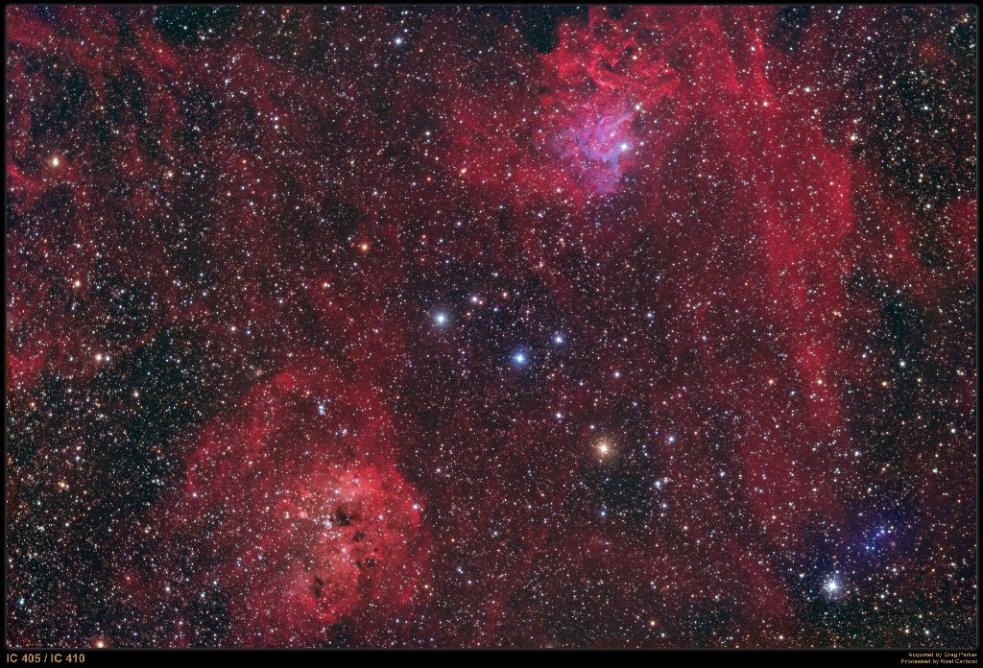
The "69" nebulae...

Click on image to enlarge

Object: IC 410 and IC 405 (The "Flaming Star" Nebula, Caldwell 31)
Type: Emission Nebulae
Distance: 1,600 light years
Constellation: Auriga
Date: 23 January 2009
Equipment: SXV-H9, Zeiss 135mm telephoto lens @ f3.5 (40 mm aperture), ATIK filter wheel with Ha, G&B filters
Subframes: 40 x 200s 2x2 binned subframes in H alpha, 12 x 200s 2x2 binned in G, 5 in B, 16 darks, 16 flats/flat darks in Ha, calibrated and stacked in AIP4Win. Final processing in AstroArt, Paint Shop Pro7 and NeatImage.

Despite an ever-increasing haze that cut short my imaging session for this one (hence only 5 blue subs in the end), I was reasonably pleased with the end result. I had planned to take loads more subs if the sky held but given recent history, I was glad I had decided to take a few subs through each filter in turn rather than long sessions through each one.

The channels were stacked in AIP4Win and assigned and aligned in PSP7. The final image was a touch noisy because of the small number of subs, but a quick pass with the freebie version of NeatImage did quite a reasonable job in cleaning it up.

As for the name I gave it, I was just surprised at how sharp the "small 6" of IC410 and "big 9" of IC 405 stood out on the H-alpha frame. The effect isn't quite so striking on the final colour version.

Maybe the final result maybe isn't as good as this one from Greg Parker's New Forest Observatory, but given my somewhat "lower budget" set-up (below), I think I've got value for money on this occasion - especially given the weather...

The shot above (click on the image for a clearer view) shows my current system for wide-field imaging. The equipment is all mounted on a Vixen plate, with the SXV-H9 clamped in a simple bracket made out of a bit of copper tube that I flattened down and drilled. This allows me to rotate the camera for image framing. The filter wheel and lens (with mandatory dew heater) sit on the camera: I've found the filter wheel leaks a bit of light so that's what the silver foil is for. An old Celestron 7 x30 finder is used for rough alignment, with the Vixen guidescope and reticule eyepiece that's above it being used for precise alignments.

It's a simple and robust set-up that stands up quite well to being bounced around on my gadget box when I roll it out of the garage.


Friday, 23 January 2009

Messier 45 - The Pleiades...

Click on the above image to enlarge
Object: Messier 45
Type: Open Cluster
Distance:
407 light years
Constellation: Taurus
Date: 18 January 2009
Equipment: SXV-H9, Zeiss 135mm lens, ATIK filter wheel, Astronomix LRGB filters
Subframes:
30 x 300s full resolution subframes (luminance), 20 x 200s RGB 2x2 binned, 16 flats/flat darks (no darks) in luminance, channels calibrated and stacked in AIP4Win. Final processing in AstroArt and PSP7.

It really has been an exceptionally poor winter for imaging so far, has it not? On the few nights that stars are actually visible, there has been a mist lurking around, robbing the sky of any sort of clarity needed for deep-sky work. This particular evening was not really much better but it had been so long that I’d thought I’d give it a go on something bright, like M45, an object I’d never really had much luck in imaging in terms of capturing the delicate nebulosity that suffuses its stars.

Seeing started poor and a high haze became increasingly heavy during this imaging session. I shot what were going to be the luminance frames for the image (200s at full resolution through a UV/IR blocker) first, followed by the red and green frames at 2x2 resolution, and all the while the sky background on the images was getting brighter and brighter. When I finally shot the series of 200s blue frames, I was amazed at how burnt out the stars looked compared to the red and green channels – perhaps an indication of just how “blue” the Pleiades are (or perhaps the lens has a touch of chromatic aberration). I was going to shoot a series of frames at shorter exposures, but by then the stars were virtually hazed out, so I gave up.

The blue frames were a write-off, so I used the luminance channel as the blue one, and pieced together an RGB composite in Paint Shop Pro. This was a bit fiddley as I’d resized the 2x2 binned red and green channels in AIP4Win to match the full resolution luminance channels. In PSP, not only were those images very slightly smaller than the “unresized” ones, there was a bit of rotation as well, probably because I’d had to reverse the equatorial mount between the red and green frames.

The high haze had also caused some horrible gradients across the raw images, and the stacked ones took quite a bit of processing to flatten them out.

It was all a bit much for the AstroArt RGB processing package, which couldn’t stack the colour frames and introduced a load of new coloured gradients anyway, hence a bit of laborious trial and error work to rotate and resize the composites in PSP7 to get something that could be aligned accurately enough to avoid odd and unequal flaring effects on the stars.

With all of this heavy processing, the final image isn’t too brilliant. The brighter stars are still a bit burnt out – you can’t pick out the three small stars just west of Alcyone, for example, which the best shots can clearly resolve. The nebulosity around Merope and is also rather restricted and doesn’t show the “brush-strokes” you see in really good images of this area of the sky.

Whether that’s down to the poor conditions at the time, a poor processing technique and/or insufficient resolution from the 135mm telephoto lens, I’m not sure.


There are certainly better shots of M45 out there than this one. I think I’ll give up on it for now…

Monday, 29 December 2008

The Leo Trio...

Objects: NGC 3628 (top), Messier 65 (NGC 3623, lower right), Messier 66 (NGC 3627, lower left)
Type: Galaxies
Distance:
25 million light years (NGC 3628), 24 million light years (M65), 21.5 million light years (M66)
Constellation:
Leo
Date: 08 April 2008
Equipment: SXV-H9, Vixen ED114S (f.l. 600mm)
Subframes:
60 x 120 second 2x2 binned subframes, 16 darks, 16 flats/flat darks, calibrated and stacked in AIP4Win. Final processing in AstroArt and PSP7.

A very clear, almost moonless night and the AstroArt maximum entropy deconvolution filter both played a part in obtaining crisp, tight star images and a good level of detail in these three galaxies that comprise this well-known grouping.

The refractor's 600mm focal length was ideally suited to the framing of all three galaxies on the SXV-H9 chip without having to resort to a mosaic.

Click on the image to enlarge.

Monday, 22 December 2008

Moon...

Date: 24 January 2008
Equipment: SXV-H9, Vixen f5.3 ED refractor (f.l. 600mm)
Subframes: 20 x 0.001 second subframes in OIII, stacked in Registax 2.1. Final processing in PSP7.

Another simple moon shot from a night of terribly unsteady seeing. The OIII filter has generated some excellent contrast of the marias from the highlights and crater debris, especially with the great crater rays of Copernicus and Tycho.

Saturday, 20 December 2008

Messier 35

Object: Messier 35 (NGC 2168)
Type: Open Cluster
Distance: 2800 light years
Constellation: Gemini
Date:
24 January 2008
Equipment: SXV-H9, ATIK manual filter wheel with Astronomix LRGB filters, Vixen ED114S (f.l. 600mm)
Subframes: 20 x 120 second (luminance), 20 x 60 second 2x2 binned subframes each for R,G and B channels, 16 darks, 16 flats/flat darks, calibrated and stacked in AIP4Win. Final processing in PSP7.

Using my usual "false colour" processing methods for colour renditions of open clusters doesn't work too well. To prepare the above image (click on it to enlarge if you so wish), I used data from monochrome images obtained through colour filters. To try and get realistic colours, I scanned the filters I used into a reference frame, and produced colour masks for each colour channel that were exactly the same colour as that of the filter as scanned in to PaintShop. I then layered each colour channel over the luminance frame, and adjusted the intensity of each layer based on the spectral response for the Sony ICX285AL chip in the SXV-H9.

The result was a load of odd-coloured stars against a dark green sky, so I stopped trying to be clever and just blended the LRGB channels in PSP7 until I got something that looked about right, which is what you see above. The red colour of M35's "neighbouring" cluster, NGC 2158 (a line of sight effect - it lies six times further away) has not been exaggerated compared to the bluish tinge of M35's stars: that's just how they have turned out relative to each other in processing. Looking at other images of this pair of clusters (e.g. such as Rob Gendler's effort here), the colours I obtained seem geniune enough, although "colour" in astrophotos is always a subjective thing. Fans of the "Hubble Pallette" have their very own preference for the psychedelic, after all.

This was the first time I had tried to do "proper" LRGB imaging with a resasonable number of subframes and it's worked out OK. I can see why "one shot" colour CCDs are so popular though, (although I think my skies are too sodiumed-up to allow subjective colour imaging and I prefer the increased sensitivity of the monos as well): gathering the input for separate subs and pasting them all together for a colour composite was quite time consuming.

The of M35 image below is a much earlier one from January 2004:

A single 60 second frame taken by afocal projection through a 25mm eyepiece using a Casio QV-3500EX digital camera gives a reasonable impression of what the cluster looks like under dark skies through an eyepiece, although a hint of star colour is seen in the image. NGC 2158 is barely discernable. Click on the image to enlarge.